
There is a scale of project at which conventional tools start showing their limits. Not because they’re poor tools, but because they were designed for a different kind of work. A ten-story residential building and a high-complexity hospital are not the same problem at different sizes: they are qualitatively different problems that demand different capabilities at every stage of the process.
Architects and civil engineers who work on large-scale projects know this well. Coordination between disciplines becomes exponentially more complex. Documentation grows until it becomes unmanageable with traditional workflows. Interference errors between structures, systems, and architecture are detected late, when correcting them already costs time and money. And communication with clients, contractors, and public agencies demands levels of precision and traceability that few platforms can guarantee.
Bentley Systems exists to solve exactly that kind of problem.
A platform built for complexity
Bentley Systems is not a modeling software with BIM functions added on. It’s a complete engineering tool ecosystem that covers the entire project lifecycle: from site survey to built asset management, through design, multi-discipline coordination, structural analysis, and technical documentation.
Its approach is designed for projects where multiple disciplines work simultaneously: architecture, structure, mechanical, electrical, and plumbing systems, road infrastructure, and more. In that context, the platform functions as the central system that integrates the work of all teams into a single federated model, where every discipline sees the complete project and can detect clashes before they reach the construction site.
For architects and civil engineers working on public tenders, hospitals, airports, corporate buildings, road infrastructure, or mixed-use projects, that level of integration is not a luxury: it’s an operational necessity.
MicroStation: the design environment that holds the entire ecosystem together
The heart of the Bentley ecosystem is MicroStation, the design and documentation platform on which most of the company’s specialized applications are built. For professionals coming from the CAD world, MicroStation offers a familiar but notably more powerful environment: 2D and 3D work capability within the same interface, large file handling without performance degradation, and broad compatibility with DWG, DGN, IFC, and other BIM ecosystem formats.
But MicroStation is not just an advanced drafting tool. It’s the foundation on which architects and engineers can build information models that automatically feed the project’s technical documentation, budgets, and schedules. Every change in the model propagates coherently to all derived documents, eliminating the risk of working with outdated information.
For teams producing large volumes of technical documentation, that automatic coherence between model and documents can mean the difference between an orderly tender process and one filled with last-minute revisions.
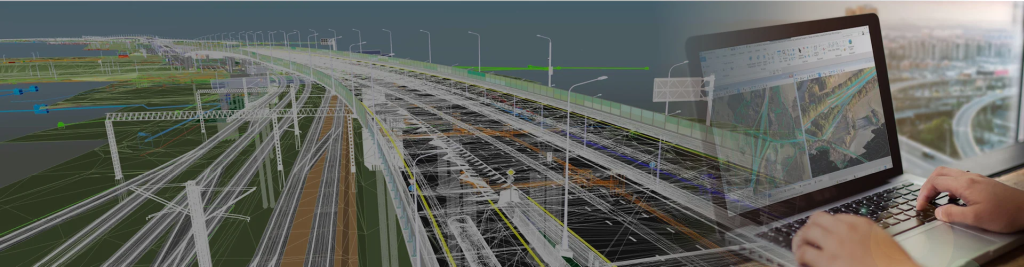
OpenRoads and OpenBuildings: when architecture integrates with infrastructure
Two of the most relevant applications in the Bentley ecosystem for architects and civil engineers are OpenRoads Designer and OpenBuildings Designer.
OpenRoads Designer is oriented toward road infrastructure design: highways, intersections, drainage, earthworks. It allows work with real terrain models, simulates the behavior of the alignment under different conditions, and automatically generates the technical documentation required for tenders and approvals. For civil engineers working on public infrastructure projects, it’s the tool that replaces fragmented workflows across multiple software with an integrated and traceable environment. More information at bentley.aufieroinformatica.com.
OpenBuildings Designer, for its part, is oriented toward medium and large-complexity buildings. It allows design and documentation in BIM with a level of detail that includes architecture, structure, and systems in a single model, with automatic extraction of floor plans, quantity takeoffs, and specifications. Its IFC compatibility facilitates coordination with consultants using other platforms, making it an especially useful tool in projects with many stakeholders working across different software.
The real power appears when both tools are used together: an infrastructure project that includes buildings — such as a transport terminal, a university campus, or a hospital complex — can be coordinated in a single environment that integrates road infrastructure, the building, and all its systems.
iTwin: the digital twin that transforms project management
One of the most advanced capabilities in the Bentley ecosystem is iTwin, its digital twin platform for infrastructure. A digital twin is a real-time virtual representation of the built asset, fed by data from the BIM model, on-site sensors, and management systems.
For architects and engineers working on large-scale projects, iTwin allows monitoring of construction progress against the design model, detecting deviations before they become major problems, and managing the built asset with precise information on every component of the building or infrastructure.
It’s a capability that changes the nature of the professional’s work: from designing and documenting to designing, building, and managing with integrated information at every stage. For public infrastructure projects, corporate buildings, or industrial facilities where asset management holds as much value as the original design, iTwin opens a dimension of service that few platforms can offer.
Interoperability: the common language of complex projects
One of the greatest challenges in large-scale projects is interoperability: making data flow without loss between the software of different disciplines and different project stakeholders. A structural model in one format, systems in another, architecture in a third: without a clear interoperability strategy, the federated model becomes a source of conflict instead of a solution.
Bentley Systems built its ecosystem with interoperability as a central principle. Its applications work natively with IFC, the open BIM data exchange standard, ensuring that information flows correctly to and from other ecosystem platforms: Archicad, Revit, AutoCAD, SketchUp. In addition, its DGN format is broadly compatible with the leading software on the market.
For projects where the client or tendering agency requires IFC deliverables, or where the project team uses different platforms, that native interoperability eliminates friction and reduces the risk of coordination errors.
Aufiero Informática: access to the Bentley ecosystem in Latin America
Bentley Systems has a global presence, but accessing its solutions with local support, in Spanish, and with conditions adapted to the Latin American market is a meaningful differentiator when critical projects are at stake.
Aufiero Informática is an authorized Bentley Systems distributor in Latin America and can advise on the most suitable applications based on the type of project and team profile, available licensing options, and training programs to incorporate the tools into existing workflows.
To learn about the options available for your firm or company, visit us at bentley.aufieroinformatica.com.
Frequently asked questions
Is Bentley Systems only for large companies, or can a mid-sized firm use it too?
Bentley has solutions for different work scales. While its ecosystem is especially powerful for highly complex projects, applications like MicroStation or OpenBuildings Designer are accessible to mid-sized firms working on architecture or engineering projects of a certain scale. The key is identifying which ecosystem applications best fit the firm’s type of work.
Is Bentley compatible with Archicad or Revit?
Yes. The Bentley ecosystem works natively with IFC, the open BIM data exchange standard, ensuring compatibility with Archicad, Revit, and other ecosystem platforms. Its applications also read and write DWG, facilitating collaboration with teams working in AutoCAD.
What is the difference between MicroStation and AutoCAD?
Both are CAD design environments with 2D and 3D capabilities, but MicroStation is designed for projects of greater complexity and scale. It handles large files more efficiently, has more advanced native 3D working capabilities, and is the foundation on which Bentley’s specialized infrastructure and building applications are built. For large-scale civil engineering or architecture projects, the differences in performance and capability are significant.
What is a digital twin and what is it used for in architecture?
A digital twin is a virtual representation of the building or infrastructure, fed by BIM model data and, in some cases, real-time sensors. In architecture and engineering, it allows construction progress to be monitored against the design, deviations to be detected, and the built asset to be managed with precise information on every component. It’s especially valuable in public infrastructure projects or highly complex buildings where post-construction management holds significant value.
How is the Bentley ecosystem licensed?
Bentley offers different licensing models based on user type and work volume, including annual subscriptions and access to multiple applications under a single scheme. Aufiero Informática can advise on the most suitable options based on the firm’s or company’s profile and scale of work.